
Lecture 6: The Bigger Picture#
Please:
sign attendance sheet
put away devices
Guest speaker#
Michael Freedman is a Brooklyn-based visual artist and creative technologist whose work moves between observation and systemic inquiry. For over 30 years, he’s painted and drawn the world around him—portraits, landscapes, gestural studio paintings, and, more recently, quick, meditative ink drawings made while walking through the city. He’s drawn to stillness and structure, but also to the chaotic energy of people and streets. More recently, he created CrashCountNYC, a data-driven project documenting traffic violence in New York City.
Questions?#
Final Project#
How did it go?
Peer grading#
Version control#
Make your own Markdown file under
people/, based on Aidan’s.You’ll need to create / sign into your GitHub account.
Commit and send a pull request.
You’ll be asked if you want to Fork.
Why?
Click yes.
Review pull request of your neighbor.
Ask Me Anything (AMA)#
Have slides on “Python beyond data analysis” as backup, but would rather talk about what you want to hear about.
Data warehousing#
Python beyond data analysis#
We’ve been focusing on using Python and pandas for data analysis. What else is Python used for?
Data engineering#
Automation / recurring processes
Copying/moving/processing/publishing data, especially Big Data
Monitoring/alerting
Web development#
Building web sites that are interactive (more than just content)
Forms
Presenting data
Workflows, such as:
Signing up for things
Paying for things
Machine learning#
Statistics, but fancy
Building models
Finding patterns
Recommendations
Detection
When people say “artificial intelligence,” they usually mean “machine learning.”
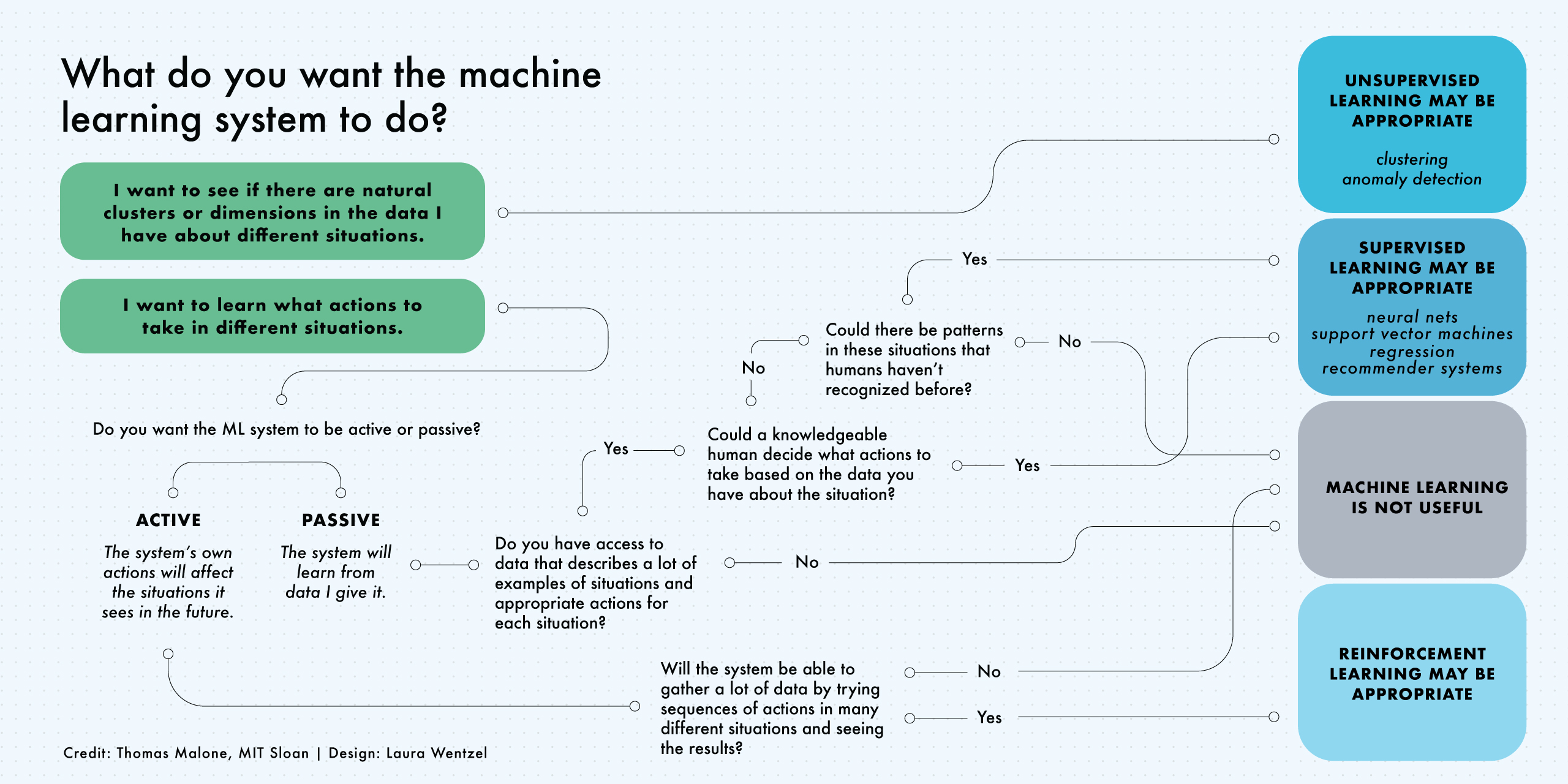
Source, with more thorough explanation
The process#
High-level
Create a model
Gather a bunch of data for training
If supervised machine learning, label it (give it the right answers)
Segment into training and test data
Train the model against the training dataset (have it identify patterns)
Test the model against the test dataset
Run against new data
If reinforcement learning, model refines itself
You have a head start: The fundamentals are applicable anywhere you’re using code.
Resources#
Post-Google Colab#
Google Colab instance (and your copy of files) will be deleted
Download things you want to keep, particularly edited notebooks
Class materials will remain available on the site and through GitHub
Course evaluations#
They are:
Totally anonymous
Not visible to me until grades are released
A big help. Some things I took from the past:
Making assignments more rigorous
Students are hungry for more
People like the in-class exercises
More info. Please complete now, if you haven’t already.
Thank you!#
Keep in touch.